

Portable Storage Units for Moving House: What to Know
Last Updated: October 26, 2026
Quick Summary
Portable storage units are lockable containers delivered to your property, packed at your own pace, then collected and stored or transported to your new address. You load the container yourself over days or weeks, and the provider collects it when you are ready, so delivery, loading and collection happen on your schedule rather than a truck company's.
- Check driveway access before booking, because a failed delivery attempt can cost you a fee.
- If you are within 10 per cent of a unit's volume limit, size up rather than down.
- Ask whether the quoted rental period includes delivery and collection days or counts them as hire days.
- Moving pods suit households that want to pack gradually; self-storage suits people who need frequent access.
- Confirm strata or council rules on containers before delivery day, or you may be asked to move it at short notice.
Table of Contents
- How Portable Storage Units Work on a House Move
- Portable Storage Unit Sizes and What Each One Holds
- Moving Container Costs: What Drives the Price
- Moving Pods vs Self-Storage for Moving House
- Self-Storage for Moving House: When It Still Makes Sense
- Access, Site Preparation and Delivery Constraints
- Packing for a Portable Unit: What to Use Inside
- Choosing Your Storage Setup Before You Book
- Frequently Asked Questions
How Portable Storage Units Work on a House Move
A portable storage unit is a lockable container delivered to your property, packed at your own pace, then collected and stored or transported to your new address.
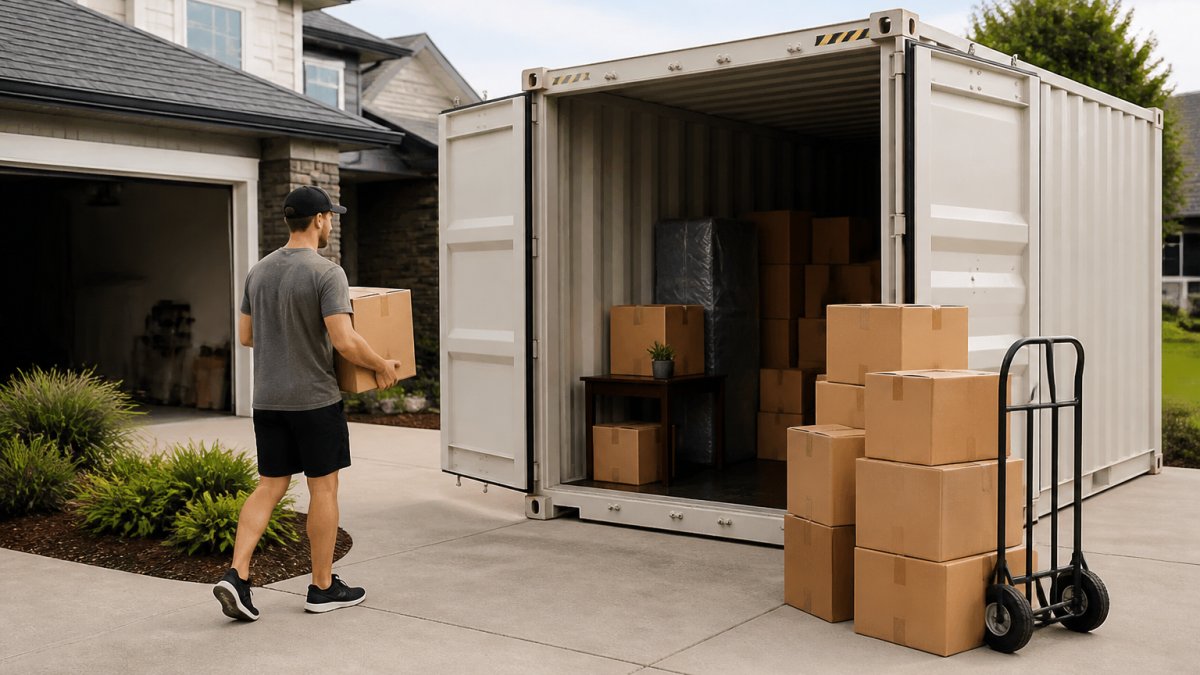
With portable storage units, the container arrives, you load it over days or weeks, and the company collects it when you are ready.
The trade-off is that you do the packing and loading yourself.
Delivery, Loading and Collection
The sequence is straightforward:
- Book a container size and delivery date.
- The unit is dropped at your address and levelled on solid ground.
- You pack and load at your own pace, locking the door between sessions.
- The provider collects the unit and either stores it or delivers it to your new address.
Watch out: driveways with steep slopes, soft ground or low overhead branches can block delivery. Check access before you book, because a failed delivery attempt can cost you a fee.
Portable Storage Unit Sizes and What Each One Holds
Container sizes vary by provider, but the practical question is capacity, not dimensions. Providers usually quote internal volume in cubic metres, and the useful comparison is that volume against the floor area and furniture load of your current home.
As a working guide, the table below maps common unit sizes to household types. Treat the cubic-metre figures as typical ranges to confirm with your provider, not fixed specifications.
| Unit Size | Typical Internal Volume | Fits Roughly | Watch Out For |
|---|---|---|---|
| Small | Around 6-9 m³ | Studio or one-bedroom flat: bed, sofa, boxes, small appliances | Bulky whitegoods can consume most of the space |
| Medium | Around 12-16 m³ | Two-bedroom home: two bedrooms of furniture plus whitegoods | Mattresses and wardrobes eat volume fast |
| Large | Around 20-25 m³ | Three-bedroom house: full household including outdoor furniture | Door height may limit tall items |
How to Choose a Size Without Overpaying
A common mistake is underestimating how much space bulky furniture consumes once it is loaded. A sofa that looks compact in a lounge room can take up a quarter of a small container once packing gaps are filled.
Use this method before you book:
- Walk through each room and list the large items, beds, wardrobes, sofas, fridges, washing machines, dining tables.
- Estimate each large item's footprint in cubic metres (length × width × height), then add roughly 20 per cent for packing gaps and soft furnishings.
- Add boxed goods room by room; most households find boxes account for a surprisingly large share of volume.
- Compare your total to the provider's internal volume, and size up rather than down if you are within 10 per cent of the limit.
Sizing by Move Type
- Apartment or unit move: a small unit is often enough, but check whether the building's loading zone or lift can accommodate the container's delivery vehicle.
- Downsizing: a medium unit usually covers the furniture you are keeping while the rest is sold or donated; measure the items going into the new home first.
- Renovation or delayed settlement: size for the whole household, because you may be storing everything for weeks rather than days.
If you are unsure, ask the provider to recommend a size based on your room count and large-item list, and get that recommendation in writing so you have a reference point if the load does not fit.
Moving Container Costs: What Drives the Price
Moving container costs come down to five things: delivery, collection, transport distance, how long you keep the unit, and what access you need while it is stored. A local move with a short rental period costs far less than an interstate move with weeks of storage in between, but the gap between a cheap quote and an expensive one usually comes from the fees that were not listed up front.
Ask for a written quote that separates each charge:
- Delivery fee (often charged per trip, not per move)
- Collection fee
- Monthly rental or storage fee
A transparent quote lists these separately. If a provider quotes one lump sum, ask what happens if your settlement is delayed and you need the unit an extra fortnight. That is where cheap quotes turn expensive, a daily or weekly rate applied after the included period can add more than the original delivery fee.
Comparing the Three Main Options on Total Cost
The useful comparison is not the headline rental rate. It is the total cost of the move across the same scope: same household, same distance, same storage duration. The pattern below generally holds, though exact figures depend on your postcode, access and season.
| Cost component | Portable container | Traditional removalist | Self-storage |
|---|---|---|---|
| Loading labour | You (or hire separately) | Included | You (or hire separately) |
| Transport to storage | Included in hire | Included in quote | You arrange and pay |
| Storage during gap | Included in rental | Not included | Paid per unit per week |
| Access while stored | Limited, by arrangement, sometimes charged | None | During office hours, usually free |
| Extra fees to watch | Failed delivery, re-delivery, extended hire | Stair or long-carry surcharges, after-hours rates | Admin fee, lock purchase, insurance |
Two patterns are worth knowing before you request quotes. First, a removalist quote bundles labour and transport, so it looks expensive next to a container hire rate, but if you would otherwise pay for loading help, the gap narrows. Second, self-storage looks cheapest per week but only if you can move the contents yourself; once you add a truck hire and a second pair of hands, the container often wins on convenience for the same money.
Questions That Reveal the Real Price
- Is the quoted rental period inclusive of delivery and collection days, or do those count as hire days?
- What is the daily or weekly rate after the included period?
- Is there a fee if the container cannot be placed where you asked?
Get the answers in writing. A provider that will not separate the fees is telling you something about how the final invoice will look.
Moving Pods vs Self-Storage for Moving House
Moving pods keep your belongings on your own property while you pack, which removes the need to hire a truck and drive loads across town. Self-storage for moving house requires you to transport everything to a facility yourself, then unload it into a unit.
Here is the honest comparison:
| Factor | Moving Pod | Self-Storage |
|---|---|---|
| Transport to storage | Provider handles it | You handle it |
| Packing location | Your driveway | At the facility |
| Access while stored | Limited, by arrangement | During office hours |
| Best for | Busy households, local moves | People who need frequent access |
Moving pods suit households that want to pack gradually. Self-storage suits people who need to grab items regularly during a renovation.
Foldable Storage Cart with Wheels →
Self-Storage for Moving House: When It Still Makes Sense
Self-storage remains the better choice in specific situations. If you need to retrieve items weekly, a facility with drive-up access beats a container parked at a depot.
It also works well for gap periods.
The Australian Competition and Consumer Commission guidance on consumer guarantees is worth reading before you sign any storage contract, because your rights apply to storage services too.
Access, Site Preparation and Delivery Constraints
Site preparation decides whether your booking runs smoothly. A container needs a flat, firm surface, clear overhead space and enough room for the delivery truck to reverse in.
Check these before booking:
- Driveway width and turning space
- Overhead power lines or tree branches
- Ground firmness after rain
Watch out: many strata schemes and local councils restrict how long a container can sit on common property or the street. Confirm the rules before delivery day, or you may be asked to move it at short notice.
Packing for a Portable Unit: What to Use Inside
Packing well protects your belongings and maximises the space you paid for. Load heavy items at the bottom and against the walls, keep a walkway down the centre, and fill gaps so nothing shifts in transit.
Practical packing assets to have on hand:
- Sturdy boxes, uniform in size, stacked flat and tight
- Packing blankets for furniture corners and tabletops
- A moving trolley to save your back on long driveways
For smaller items, a 5-tier clear storage box with handles keeps medicines, cosmetics and craft supplies sorted and visible. Bulky soft items fit neatly into a large cylindrical fabric storage bag, and a six-piece travel organiser set helps sort clothing before it goes into the container.


Label every box by room, not by contents. When you unload, you will know which boxes belong in the kitchen without opening them.
Choosing Your Storage Setup Before You Book
Before you commit, match the setup to your move type. Renters in apartments with no driveway should look at self-storage or a smaller delivered unit.
Two resources help you decide what durable storage to buy before you book: our heavy-duty storage guide for chaotic families and how to tell if shelving is durable. Both cover what to look for so your storage survives the move and the years after it.
If you are weighing storage products for the new home, StorageCentral stocks wardrobe, kitchen and workshop options that are portable enough to take with you.
The National Storage and Logistics Association industry guidance notes that flexible rental periods and clear access terms are the two factors renters ask about most. Get both in writing before you pay a deposit.
Frequently Asked Questions
How much do portable storage units cost for moving house?
Pricing varies by provider, container size, rental length and delivery distance, so there is no single figure. Expect to pay for delivery, collection and each week or month the unit stays on site or in a depot. Ask for a written quote that itemises every charge, including redelivery if your dates change. Compare that total against a removalist quote and a self-storage quote for the same period before deciding.
What size portable storage unit do I need for a house move?
Match the size to your household. A studio or one-bedroom flat usually fits in the smallest option, a two-bedroom home needs roughly double that, and a three-bedroom house with a garage typically needs the largest size available. Measure bulky items like fridges, couches and mattresses first. If you are between sizes, size up: an overfilled unit makes loading harder and can damage items in transit.
How long can I keep a portable storage container?
Rental periods are flexible and usually billed weekly or monthly, so you can keep a unit for a few days during a settlement gap or for several months during a renovation. Longer rentals often attract a lower rate per week. Confirm the minimum hire period and any extension fees before booking, and check whether the unit can stay at your property or must return to a depot between moves.
Are moving pods better than self-storage for moving house?
It depends on how much lifting you want to do. Moving pods are delivered to your door, so you load at your own pace without hiring a truck or driving to a facility. Self-storage suits people who need frequent access or have only a few items. For a full house move with a settlement gap, a delivered container usually saves time and avoids double handling.
What should I check before booking a moving storage container?
Confirm the delivery date and any access limits such as narrow driveways, low branches or body corporate rules. Ask what happens if your settlement is delayed, whether the unit is weatherproof and lockable, and what insurance or liability cover applies to your contents. Check the prohibited items list, then book a week earlier than you think you need to allow for packing.
Moving house is stressful enough without storage surprises. StorageCentral can help you organise before the container arrives with wardrobe systems, kitchen storage and portable options designed to move with you. Browse our range and get your home packed properly before the truck pulls up.
